
How Much Income Do You Need to Purchase a Used Car in Jefferson City and Morristown, TN?
How Much Income Do You Need to Purchase a Used Car in Jefferson City and Morristown, TN?

Most lenders typically want to see about $1,500–$2,000 in gross monthly income to purchase a used car, but the exact amount depends on your bills, credit history, down payment, and the vehicle you choose in Jefferson City or Morristown.
If you’ve been asking yourself, “Do I make enough to get approved?” you’re not alone. A lot of Tennessee buyers have steady income but still aren’t sure what lenders will accept.
The good news is that income is only one piece of the puzzle. Once you understand what lenders are really looking at, it’s easier to shop confidently and avoid wasting time.
Is there a minimum income requirement for a used car loan?
There isn’t one universal minimum income that applies to everyone. Lenders don’t use a single number because approval depends on how affordable the payment is for your overall budget.
That said, many lenders commonly use $1,500–$2,000 per month as a general starting point. Some buyers qualify with less when their monthly bills are low or the vehicle price is modest.
Lenders care most about stability and affordability. If your income is consistent and you can document it, you’re already in a better position than you might think.
What lenders really mean when they ask about income
When a lender asks for your income, they’re not only asking how much you make. They’re also asking how predictable it is and how easy it is to verify.
A higher income can still get declined if your monthly bills are too high. A lower income can get approved if the payment is small and your budget has room.
In other words, “enough income” is really “enough room in your budget for this payment.”
The core checklist lenders use to decide if your income is enough
Most approvals come down to a short list of factors. If you line these up the right way, approval becomes much more predictable.
Here’s what lenders typically weigh the most:
- Stable, documentable income
- Debt-to-income ratio (DTI) and existing monthly bills
- Credit history and recent payment behavior
- Down payment or trade-in value
- Vehicle price, mileage, and loan structure
If one area is weak, you can often strengthen another. That’s why two buyers with the same income can get different results.
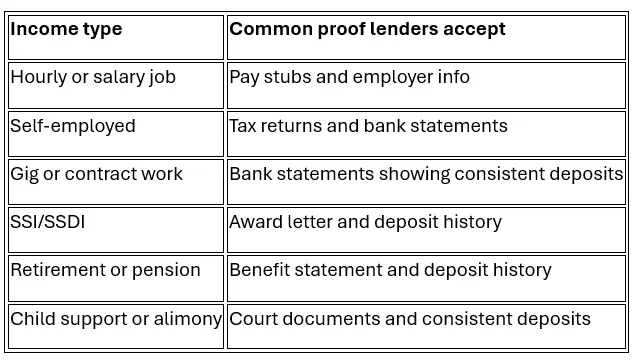
What types of income count for a used car loan?
You don’t need a traditional 9-to-5 job for your income to qualify. Many lenders accept different income sources as long as they’re consistent and can be documented.
Income that often counts includes:
- Full-time or part-time employment
- Self-employment, contract work, or 1099 work
- Gig income with a steady deposit history
- Social Security, SSI, or SSDI
- Retirement or pension income
- Child support or alimony (when documented and consistent)
If your income varies week to week, lenders may average it over time. The goal is to show that the money is reliably there.
Why debt-to-income ratio matters more than income alone
Debt-to-income ratio (DTI) is one of the biggest approval factors. DTI compares your monthly income to your monthly obligations like rent, loans, credit cards, and other recurring payments.
Many lenders prefer a total DTI of around 50% or less, although some programs can allow higher depending on the file. The lower your DTI, the easier it is to fit a car payment into lender guidelines.
If your DTI is high, your income can look “not enough” even when your paycheck is decent. That’s why payment size and vehicle price matter so much.
DTI examples
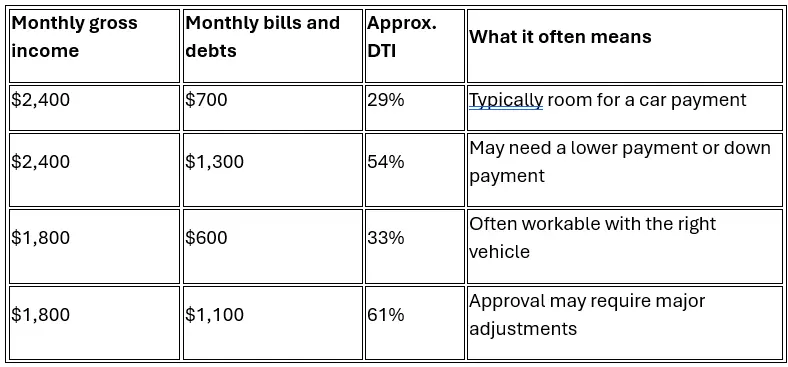
If your DTI feels tight, the solution is often a strategy, not a higher paycheck. A lower-priced vehicle, a down payment, or paying off one monthly bill can change the outcome quickly.
How much car payment can your income realistically support?
A practical budgeting guideline is keeping total vehicle costs under about 15% of your monthly income. Total vehicle costs include the payment, insurance, fuel, and basic upkeep.
This isn’t a lender rule, but it helps you avoid buying a car that feels stressful every month. It also helps when unexpected costs pop up, like tires or repairs.
Here’s a simple way to think about it: if the payment works but the insurance doesn’t, the deal isn’t really affordable.
A realistic monthly budget target
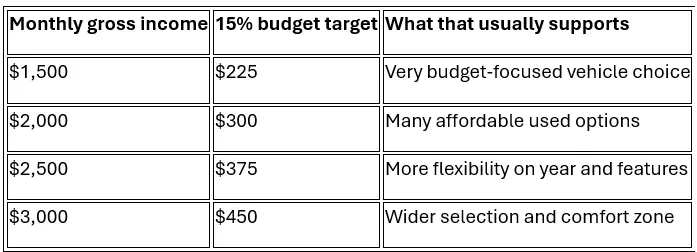
If you already have a comfortable payment range in mind, work backward from that. A lot of “income problems” are really “loan size problems.”
How employment history affects income requirements
Lenders like stability, so they usually want to see a consistent income history. A common benchmark is 6–12 months, but it doesn’t always need to be at the same employer.
Job changes aren’t automatically a deal-breaker. What matters is that your income pattern is steady and easy to verify.
If you recently started a new job in Jefferson City or Morristown, you may still qualify. It often depends on your overall file and how clean your documentation is.
What documents do lenders use to verify income?
Having your paperwork ready makes the process smoother and faster. It also reduces the chances that a lender asks for “one more thing” mid-deal.
Common income proof includes:
- Recent pay stubs
- Bank statements showing deposits
- Tax returns (especially for self-employed buyers)
- Benefit award letters (SSI/SSDI)
- A valid ID and proof of residence
If you’re paid partially in cash, deposits matter. Lenders typically need a paper trail that supports the income you list.
Income documentation checklist
How credit score changes the income you need
Credit and income work together. With stronger credit, lenders may approve a similar payment with less income because the risk looks lower.
With challenged credit, lenders usually focus more on income stability, DTI, and the structure of the deal. That often means choosing a vehicle that keeps the payment reasonable.
If you’re rebuilding credit, you’re not alone. Many buyers still qualify after late payments, collections, a repo, or bankruptcy, but timing and details affect the options.
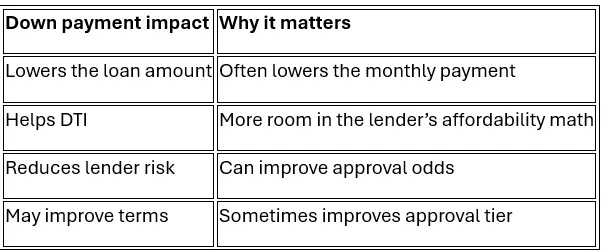
Does a down payment lower the income needed?
Yes, a down payment often makes approval easier. It reduces the amount you finance, which usually lowers the monthly payment and improves your DTI picture.
Even a modest down payment can make a big difference in how a lender views the deal. It can also open up more vehicle choices by keeping the loan amount in a safer range.
How a down payment helps
Can a trade-in reduce income requirements?
A trade-in can work like a down payment because it reduces what you need to finance. That can lower the monthly payment and make the deal easier to approve.
Even older vehicles can have value, so it’s usually worth getting it evaluated. The key detail is whether you owe money on the trade-in.
If you owe more than the trade is worth, that’s negative equity. Negative equity can raise the financed amount and may increase the income needed to qualify.
Choosing the right vehicle for your income
The vehicle you choose affects approval more than most people realize. A lower-priced vehicle generally means a smaller loan, and a smaller loan usually means a lower payment.
That’s why it’s often easier to get approved when you shop a realistic price point. You’re giving the lender a deal that fits their guidelines without stretching.
For Tennessee driving, many shoppers also consider practicality. Reliable transportation, reasonable maintenance costs, and affordable insurance usually matter more than having every extra feature.
People Also Ask questions buyers search in Tennessee
Can I get a car loan making $2,000 a month?
Often, yes, if your monthly bills aren’t too high and the vehicle payment is reasonable. Keeping DTI under control and choosing an affordable vehicle usually matters more than the raw income number.
Can I buy a used car with part-time income?
Yes, part-time income can qualify if it’s consistent and documented. Lenders usually want to see a history of deposits and a payment that fits comfortably.
How much income do I need if I have bad credit?
There’s no single number that fits everyone. Steady income, manageable DTI, and a realistic vehicle price are usually the keys, and a down payment can help reduce the payment.
What if I’m self-employed and my income varies?
Self-employed buyers often qualify, but documentation matters more. Bank statements and tax returns that show consistent income over time are typically the strongest support.
Final answer: How much income do you need?
Most buyers in Jefferson City and Morristown need around $1,500–$2,000 per month, but the real requirement depends on your debt-to-income ratio, employment stability, credit history, down payment or trade-in, and the vehicle price you choose.
If you want the simplest way to improve your approval odds, focus on the payment first. When the payment makes sense for your budget, approvals tend to get easier.
Farris Motor Company is here to help you find a dependable used car that fits your budget in Jefferson City and Morristown, TN. Browse our inventory and apply for financing today.
Frequently Asked Questions About Income for a Used Car Loan
1) What is the minimum income to finance a used car in Jefferson City or Morristown?
Many lenders commonly look for around $1,500–$2,000 in gross monthly income, but DTI, credit, and payment size usually matter more than the income number by itself.
2) Can I qualify with SSI or disability income?
Often, yes. Many lenders accept SSI/SSDI when you can provide an award letter and show consistent deposits.
3) Can I get approved with part-time work?
Yes, as long as your income is consistent and documented. Approval typically depends on whether the monthly payment fits your budget after bills.
4) Does a down payment help me qualify with lower income?
Yes. A down payment often lowers the loan amount and the payment, which can make the deal fit lender guidelines more easily.
5) Can a trade-in reduce the income I need?
Yes, if the trade-in lowers the amount financed. If you owe more than it’s worth, negative equity can increase the required income.
6) How do I know what payment I can afford before I apply?
Start with your monthly income and bills, then choose a payment range that feels comfortable. Matching that payment range to the right vehicle price is usually the fastest path.